Mythologies by Roland Barthes
The landmark work that changed how we read everyday culture — wrestling matches, soap powder, steak and chips — as systems of hidden meaning. Barthes transforms the ordinary into the extraordinary.
- Piercing semiotic analysis of modern myth and mass culture
- Essential reading in literary theory, philosophy, and cultural studies
- A foundational text that remains urgent and endlessly re-readable
Explore Mythologies by Roland Barthes
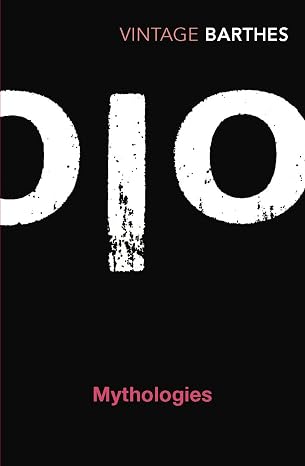
Mythologies — Vintage Barthes Edition
The bold Vintage Barthes paperback edition, with striking typographic cover design. The essential translation for students and general readers alike.
Check Price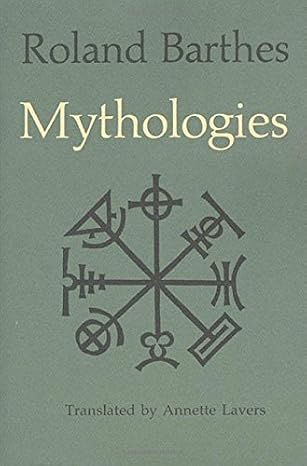
Mythologies — Annette Lavers Translation
The celebrated Annette Lavers translation in the classic sage green cover. A definitive scholarly edition widely used in universities and critical theory programmes.
Check PriceInside Mythologies
First published in France in 1957, Mythologies collects fifty-four short essays Barthes wrote for the French magazine Les Lettres nouvelles between 1954 and 1956, followed by a theoretical essay, “Myth Today.” In that closing essay Barthes outlines a second-order semiological system — myth as a metalanguage — that reads cultural signs not for what they denote but for what they connote and naturalize.
The book ranges across popular French culture: the spectacle of wrestling, the face of Greta Garbo, the new Citroën, red wine as a national totem, and the rhetoric of toys aimed at children. In each case Barthes shows how bourgeois culture presents its historically contingent values as timeless, universal facts of nature. By naming that operation, he gives readers a tool for demystification that has lost none of its power.
Annette Lavers’ translation brought the work to English-speaking audiences in 1972, and it has remained in continuous print ever since, appearing on syllabi in literary theory, cultural studies, media studies, sociology, philosophy, and art history worldwide.
How to Read This Book
- 01
Begin with the Short Essays
Open the book anywhere in the first section. Each essay is self-contained and short — typically two to four pages. Barthes chose subjects from French popular life that feel deceptively trivial: wrestling, detergent advertising, the Tour de France. Read a handful of these without worrying about sequence. You will quickly recognise the analytical move Barthes is making in each piece: taking a cultural spectacle at face value, then revealing the ideological work it is quietly doing.
- 02
Notice the Pattern of Myth-Making
As you move through the essays, pay attention to the recurring pattern: something historical and constructed is presented as natural and inevitable. Barthes calls this operation “myth.” Keep a notebook and jot down moments when you catch the same sleight of hand operating in contemporary culture around you — in advertising, news coverage, or social media. This active reading habit transforms the book from a historical document into a live analytical kit.
- 03
Tackle the Closing Essay “Myth Today”
After reading a dozen or so of the individual essays, turn to the longer theoretical essay that closes the book. “Myth Today” is denser and draws on Saussurean linguistics, but approaching it after the worked examples makes the abstract argument far more tangible. Read it slowly and in short sessions. Barthes’ key diagram — first-order and second-order semiological systems — repays careful attention and is the conceptual payoff of the whole book.
- 04
Apply the Barthesian Method to Your Own World
The most productive use of Mythologies is to treat it as a template. Choose three or four objects, images, or events from your own cultural moment — a viral photograph, a product launch, a political slogan — and write your own short Barthesian myth analysis. This exercise, popular on university courses worldwide, sharpens critical reading and deepens your understanding of how the method actually works in practice.
- 05
Explore Barthes’ Wider Bibliography
Once Mythologies has opened the door, Barthes’ other books reward exploration. S/Z extends the semiotic method to literary texts; Camera Lucida applies it with great emotional depth to photography; and Image-Music-Text collects key theoretical essays including the famous “Death of the Author.” Moving through these works in the order that interests you is entirely valid — Barthes himself resisted systematic reading plans.
Mythologies — Reader Reviews
A book that permanently changes how you see the world
Reading Barthes for the first time is genuinely disorienting in the best possible way. After spending a week with Mythologies, I found myself unable to look at advertising, sport, or the news without noticing the mythological machinery underneath. The short essays are each a small, perfectly executed act of demystification. Essential reading that earns its reputation.
— Verified reader, Cultural Studies
The Annette Lavers translation is superb
I read the Lavers translation for a graduate seminar and then returned to it several times independently. Her English captures Barthes’ dry wit and analytic precision without losing the rhetorical pleasure of the French. The classic sage green cover edition holds up beautifully over decades of re-reading. A cornerstone text in any theory collection.
— Verified reader, Literary Theory
More relevant today than when it was written
What is striking about Mythologies in the age of social media is how little the fundamental operation of myth has changed. The specific objects Barthes analyses belong to 1950s France, but the analytical framework applies with equal force to contemporary image culture, influencer marketing, and political spectacle. The Vintage Barthes edition is smartly designed and a pleasure to own.
— Verified reader, Media Studies
About the Author
Roland Gérard Barthes (12 November 1915 – 26 March 1980) was a French literary theorist, philosopher, linguist, critic, and semiotician. Born in Cherbourg and raised in Bayonne and Paris, Barthes studied classical literature at the Sorbonne and spent much of his academic career at the École Pratique des Hautes Études and later the Collège de France, where he held the Chair in Literary Semiology from 1977 until his death.
Barthes’ ideas explored a diverse range of fields — literature, photography, music, advertising, film, and fashion — and he was a central figure in the development of structuralism, semiotics, and post-structuralism. His influence shaped French intellectual life profoundly and continues to animate literary and cultural theory internationally. Major works include Writing Degree Zero (1953), Mythologies (1957), S/Z (1970), The Pleasure of the Text (1973), Roland Barthes by Roland Barthes (1975), A Lover’s Discourse (1977), and Camera Lucida (1980).
He died in Paris on 26 March 1980, one month after being struck by a laundry van outside the Collège de France. His work remains foundational across the humanities and continues to generate new readings, translations, and scholarly commentary more than four decades after his death.
Visit Official StoreFrequently Asked Questions
What is Mythologies about?
Mythologies is a 1957 collection of essays by Roland Barthes in which he analyses objects and events from French popular culture — wrestling, toys, steak, soap powder, the Citroën — as signs within a second-order semiological system. The book argues that bourgeois culture naturalises its historically contingent values, presenting them as universal and inevitable. Barthes names this operation “myth” and provides a theoretical framework, in the closing essay “Myth Today,” for identifying and resisting it.
Which edition or translation should I choose?
Two principal editions are widely available. The Annette Lavers translation (the classic green-cover edition) has been the standard English version since 1972 and is the edition most used in academic contexts. The Vintage Barthes edition features a modern typographic cover design and is the same reliable text in a well-produced contemporary format. Both serve general and scholarly readers equally well; the choice is largely one of personal preference and price.
Is Mythologies suitable for readers new to literary theory?
Yes. The short essays that make up most of the book require no specialist background. They are playful, precise, and often funny, and Barthes’ method becomes clear through the accumulated examples. The closing theoretical essay “Myth Today” is denser, but readers who tackle it after the practical examples find it far more approachable than its reputation suggests. Mythologies is regularly assigned as a first text in introductory theory courses precisely because it rewards both casual and close reading.
Is Mythologies still relevant today?
Very much so. While the specific cultural objects Barthes analyses belong to 1950s France, the analytical framework he develops applies with equal force to contemporary advertising, political communication, social media imagery, and celebrity culture. The basic operation of myth — the naturalisation of the historical — has not changed. Many scholars and educators argue that Mythologies is more urgently necessary in the age of digital image culture than it was when first published.
What should I read after Mythologies?
Readers who enjoy Mythologies typically find Image-Music-Text a natural next step, as it collects key essays including “The Death of the Author” in an accessible format. S/Z extends the semiotic method to a sustained close reading of literature, while Camera Lucida offers a more personal and emotionally direct application of Barthesian analysis to photography and grief. For broader context, introductions to structuralism and French theory of the 1960s and 70s provide useful background.